Digital Payments in Nepal: eSewa vs Khalti by IME vs Mobile Banking Apps (2026 Guide)
A practical Nepal-focused guide to choosing between eSewa, Khalti by IME and mobile banking apps for QR payments, bills, transfers and everyday use.

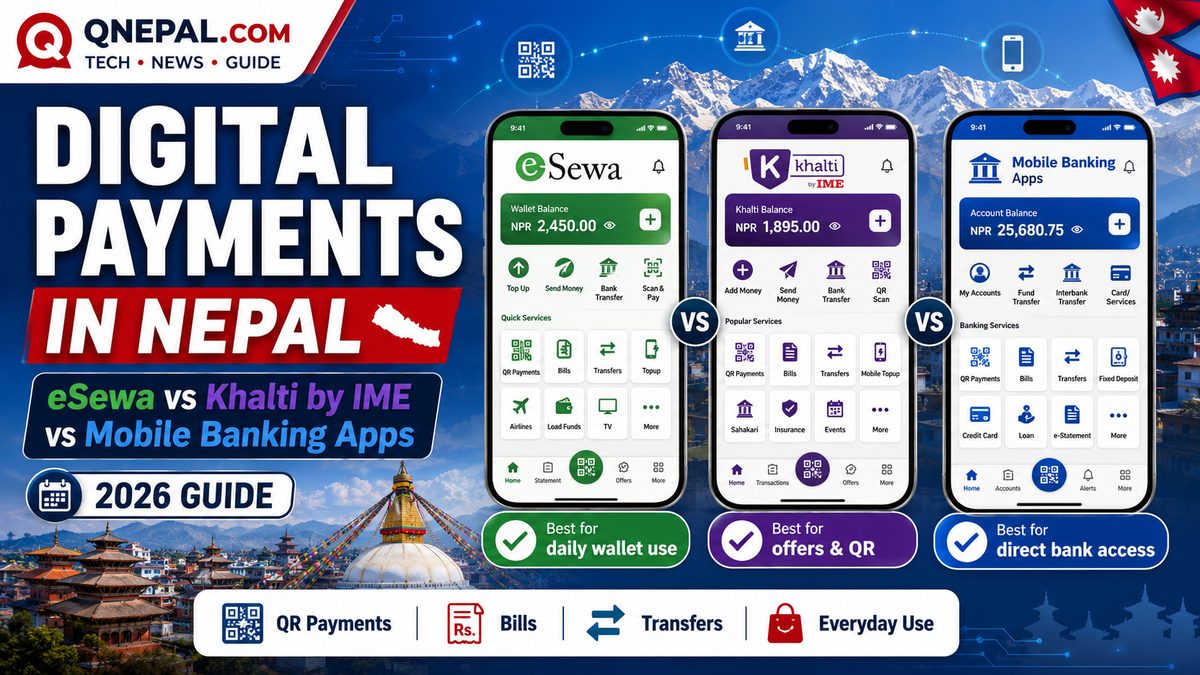
Quick answer: There is no single best digital payment app for everyone in Nepal in 2026. eSewa still matters for broad merchant acceptance and utility payments, Khalti by IME is becoming a stronger all-in-one fintech app after the merger, and mobile banking apps are often the most practical choice when you mostly pay through interoperable QR and direct bank balance. The right choice depends on whether you care most about merchant coverage, wallet offers, remittance convenience, or bank-linked payments.
That makes this an important gap for QNepal to fill. Nepal’s digital payment market is growing fast, but many users still choose apps based on habit, one-time cashback offers, or what a shopkeeper tells them to scan. A better question is: which payment tool actually fits your daily life in Nepal?
Why this comparison matters in Nepal right now
Digital payments in Nepal are no longer just about mobile top-ups and a few bill payments. People now use wallets and bank apps for utility bills, movie tickets, ride payments, insurance premiums, ecommerce checkouts, QR payments at local shops, and transfers between bank and wallet accounts. At the same time, the market is changing:
- Khalti and IME Pay have merged into a unified platform, which changes the old eSewa vs Khalti vs IME Pay equation.
- QR interoperability has improved, so many users can pay from banking apps instead of only from standalone wallets.
- Cross-border and ecosystem changes are making payment rails more important than just app branding.
- Security risks are rising, especially phishing, fake QR claims, and social engineering scams targeting wallet and bank users in Nepal.
If QNepal already covers payment gateway policy and eSewa usage, the next high-value editorial step is a practical consumer comparison of the country’s everyday digital payment options.
The short version
| Option | Best for | Main strengths | Main weakness |
|---|---|---|---|
| eSewa | Users who want wide service coverage and familiar merchant acceptance | Large merchant ecosystem, many billers, long user familiarity, business QR presence | Not always the cleanest choice if you already do everything from a bank app |
| Khalti by IME | Users who want a growing all-in-one fintech app with broader finance ambitions | Unified platform after merger, strong bill payment and lifestyle services, wallet plus finance positioning | Merger transition may still create habit and migration friction for some old IME Pay users |
| Mobile banking apps | Users who mostly pay by QR and want money to come straight from bank balance | No need to preload a separate wallet, strong interoperability, direct bank account control | Service discovery, offers, support and app quality vary widely by bank |
1) eSewa: still the default wallet for many Nepali users
eSewa remains one of the most recognizable names in Nepal’s digital payments market. Its biggest advantage is not just brand recognition. It is the fact that many users already know how it works, many merchants already accept it, and its ecosystem covers a wide range of services including top-up, electricity, internet bills, education payments, insurance, travel services and online merchant checkouts.
From eSewa’s public site, it clearly continues to position itself as a broad payment hub with utility payments, travel, education and merchant services, along with business QR support and a large network of partner banks.
Where eSewa is strong
- Merchant familiarity: Many small and medium merchants in Nepal have trained staff around eSewa collection habits.
- Service depth: Utility and institutional payments remain a strong use case.
- Business QR footprint: eSewa Business QR still matters for offline merchant payments.
- Bank partnership breadth: Load-fund and settlement options remain a practical strength.
Where eSewa is less compelling
- If you already use a solid mobile banking app with interoperable QR, a separate wallet can feel redundant.
- Users who mainly want direct bank-to-bank control may prefer banking apps or connectIPS-style flows.
- Wallet convenience can encourage keeping idle balance in too many apps, which makes personal finance messier.
Who should use eSewa?
eSewa is still a practical choice if you regularly pay utility bills, buy tickets, shop from merchants that actively promote eSewa, or simply want the most familiar standalone wallet experience in Nepal.
2) Khalti by IME: the most strategically interesting wallet in Nepal right now
The old comparison between Khalti and IME Pay is no longer enough, because the more important 2026 story is the Khalti-IME Pay merger. The new Khalti by IME platform is positioning itself as more than a cashback wallet. Its public messaging emphasizes a unified payment platform, seamless fund mobility, remittance connections, merchant tools, QR payments, travel services, and access to broader financial products.
That matters because Nepal’s wallet market is maturing. The winner may not be the app with the loudest discount campaign, but the one that becomes the strongest everyday financial layer for users, merchants, and partner institutions.
Where Khalti by IME is strong
- Merger scale: The combined platform can serve more users, more merchants, and a larger transaction base.
- Broader ambition: The product positioning goes beyond recharge and bills toward remittance, financial services and business solutions.
- Useful lifestyle coverage: Khalti has long been strong in tickets, ride payments, offers and consumer-facing service discovery.
- Migration path for old IME Pay users: The new structure gives former IME Pay users a route into a bigger ecosystem instead of a standalone legacy wallet.
Where Khalti by IME is weaker
- Transition friction: Mergers are strategically powerful but can confuse users during account migration, support issues or changing habits.
- Not every user needs fintech depth: If you only scan QR at local shops, your bank app may still be enough.
- Real-world consistency matters: A strong vision does not automatically mean every user will find the app faster or simpler every day.
So what about IME Pay?
For readers specifically searching for “eSewa vs Khalti vs IME Pay,” the most honest answer in 2026 is this: IME Pay should now be understood through the Khalti by IME merger context. If you were an IME Pay user, the more relevant question is whether the new Khalti platform now covers your old wallet needs while adding stronger QR, merchant and finance features.
Who should use Khalti by IME?
Khalti by IME makes the most sense for users who want a modern all-in-one payment app, regularly use merchant offers and lifestyle services, or expect one app to handle wallet payments, QR, transfers, and potentially broader finance use cases over time.
3) Mobile banking apps: the underrated winner for many people
Many Nepali users still think “digital payment” means “wallet app,” but that is no longer true. For a large share of users, especially salaried workers, students with active bank accounts, and professionals who already receive money in a bank, mobile banking apps may now be the most practical everyday payment tool.
The reason is simple: when QR systems are interoperable, you often do not need to move money into a separate wallet first. You can scan and pay directly from your bank balance. That reduces wallet clutter and gives you cleaner control over spending.
Where bank apps are strong
- Direct account control: Payments come straight from your bank balance.
- Less preloading friction: You do not have to keep topping up multiple wallets.
- Good fit for higher-trust users: Some people simply trust banks more than wallet balances.
- QR interoperability: Nepal’s broader payment ecosystem is moving toward more interoperable rails, which improves bank-app usefulness.
Where bank apps are weaker
- App quality varies a lot: Some Nepali bank apps are excellent, others feel outdated or unstable.
- Weaker consumer discovery: Wallet apps are often better at surfacing offers, merchant categories and payment campaigns.
- Support can be slow: Bank support processes are not always faster than wallet support.
Who should use mobile banking apps?
If you mostly scan QR at stores, pay from your salary account, and want fewer moving parts, your bank app may be the smartest primary payment tool in Nepal today.
Which one is best for different Nepali users?
For students
Best fit: eSewa or Khalti by IME, depending on where your campus and nearby shops accept payments most often. Students benefit from bill payments, top-ups, smaller transfers and ticketing convenience.
For salaried workers
Best fit: mobile banking app first, plus one wallet backup. If your money already sits in a bank account, direct QR and bank-linked payments are often cleaner than juggling several wallet balances.
For online shoppers
Best fit: whichever app your preferred merchants integrate best. eSewa and Khalti both matter here, but checkout support differs by store and sector.
For small merchants
Best fit: accept the rail your customers already use most. In practice, that often means supporting interoperable QR and at least one widely recognized wallet brand. Merchant convenience should be about settlement reliability, not logo loyalty.
For remittance-linked families or users
Best fit: Khalti by IME is strategically worth watching because the merged platform is explicitly emphasizing fund mobility and remittance-linked financial access.
Security checklist: what matters more than brand
Whichever app you choose, the bigger risk in Nepal now is not choosing the “wrong” wallet. It is getting scammed. QNepal has already covered Nepal’s phishing surge, and the same lesson applies here: users must stop treating payment apps as automatically safe.
- Never share OTPs, MPINs or reset codes with anyone claiming to be support staff.
- Do not scan random QR codes sent through chat apps without verifying the merchant or person.
- Keep only necessary balances in wallets you actively use.
- Turn on app lock, device lock and transaction alerts.
- Use official app downloads and official support channels only.
- Review bank and wallet transaction history regularly, especially after failed or reversed transactions.
How Nepal’s payment market is changing
Nepal’s digital payment future will likely be shaped less by single-app dominance and more by interoperability, merchant infrastructure, payment gateway regulation, and trust. That is why this topic deserves an evergreen guide rather than another thin launch post.
Three trends are especially important:
- Wallets are becoming platforms, not just wallets. The Khalti by IME merger is a clear example.
- Bank apps are becoming more competitive for everyday QR use. That weakens the old assumption that every digital payment must flow through a prepaid wallet.
- Policy and infrastructure matter more than promo campaigns. Interoperability, merchant onboarding, dispute handling and secure rails will matter more than one-time cashback wars.
Final verdict
If you want the simplest recommendation:
- Choose eSewa if you want the most familiar standalone wallet with broad service coverage and merchant comfort.
- Choose Khalti by IME if you want a more ambitious all-in-one fintech app and want to benefit from the merged ecosystem.
- Choose your mobile banking app as your primary payment tool if you already live through your bank account and mainly care about direct QR payments and account-level control.
For many Nepali users, the best real-world setup in 2026 is not one app only. It is one primary bank app plus one strong wallet backup. That gives you flexibility without scattering money everywhere.
Frequently asked questions
Is IME Pay still separate from Khalti?
No. The more relevant 2026 context is the Khalti by IME unified platform. Old IME Pay users should evaluate the merged app experience rather than think of IME Pay as a fully separate long-term choice.
Which wallet is accepted in more places in Nepal?
Acceptance depends on the merchant, QR rail and sector, but eSewa remains one of the most familiar wallet brands in everyday Nepal use. Interoperable QR has also made many bank apps more usable than before.
Is mobile banking better than a wallet in Nepal?
For many users, yes. If you mainly pay by QR and already keep money in a bank account, mobile banking can be more practical. Wallets are still useful for merchant-specific integrations, offers and certain services.
What is the safest option?
No app is safe if the user falls for phishing or shares credentials. The safest setup is the one where you use official apps, enable strong device security, verify merchants, and keep limited idle balances.
Related guides
- How to Use eSewa for Online Payments in Nepal
- Nepal May Finally Legalize International Payment Gateways
- Nepal’s Phishing Scam Surge Is Hitting Bank and Wallet Users
Sources: official public information from eSewa, Khalti, Khalti by IME, and Nepal payment ecosystem documents referenced during research.