
How Nepali Freelancers Can Receive International Payments in 2026: What Works Now, What Still Does Not, and What May Change
Nepali freelancers, agencies and remote workers still face payment friction in 2026. This guide explains what works now, what remains difficult, and how to reduce risk while getting paid from abroad.

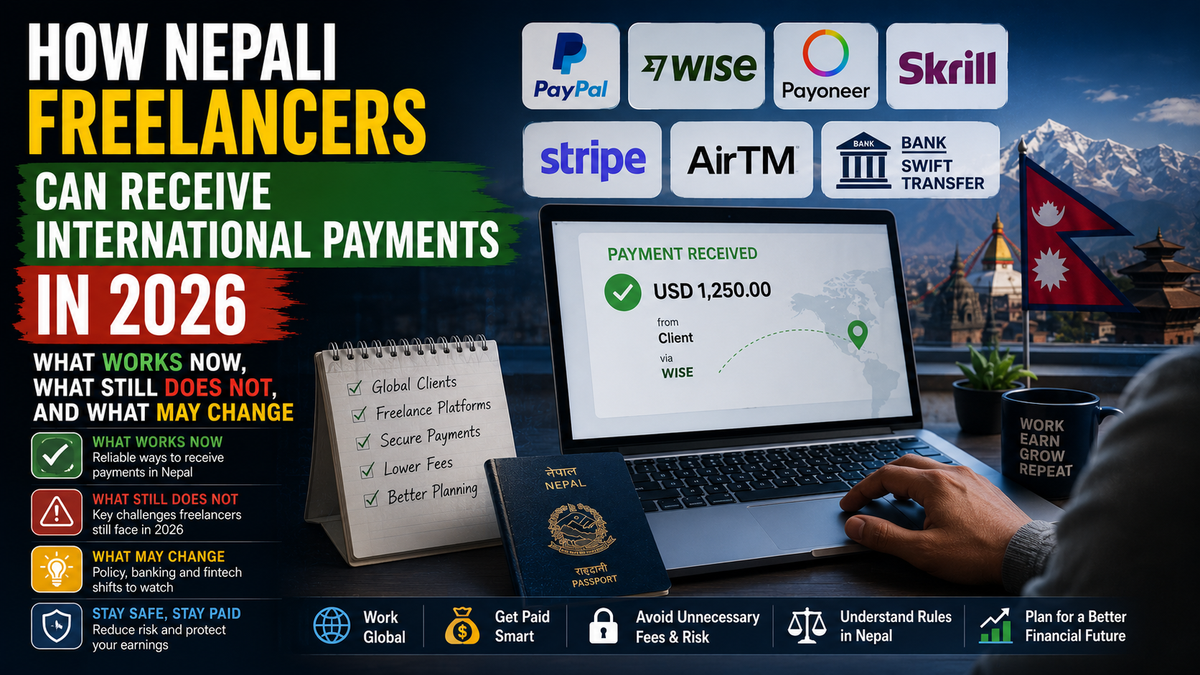
For many Nepali freelancers, the hardest part of working with foreign clients is not finding work. It is getting paid simply, legally and with low friction. Designers, developers, writers, video editors, marketers, consultants and small agencies in Nepal still deal with a payments environment that is improving in policy language but remains awkward in daily practice.
That makes this a more valuable topic for QNepal than another routine product launch. If Nepal wants more people to earn from software, services, creator work and remote jobs, then international payments are not a side issue. They are core infrastructure.
Quick answer
In 2026, Nepali freelancers can usually receive foreign income through a limited mix of bank channels, remittance-linked routes, client-platform payout systems and compliant intermediary services, depending on the client, country and work platform involved. But Nepal still does not offer the smooth mainstream global payment access many freelancers want, especially compared with markets where Stripe, PayPal receiving, and simpler international merchant tools are fully normal.
That means the smart approach is not to chase random workarounds. It is to understand which options are realistic now, where the documentation burden is, and which shortcuts create tax, account or compliance risk.
Why this matters in Nepal right now
QNepal has already covered the government’s plan to treat IT as a strategic industry and to recognise international payment gateways. That policy direction matters because it addresses one of Nepal’s oldest digital-economy bottlenecks. But until those reforms fully translate into everyday payment rails, freelancers still need practical guidance.
This affects more than full-time tech workers. It also affects:
- Students doing online gigs and internships
- Small agencies serving overseas clients
- YouTubers, creators and educators with foreign income sources
- Remote employees and contractors paid by overseas firms
- Startup founders selling services before they are fully productised
If payment friction remains high, Nepal loses export income, talent retention and trust in formal digital work.
What usually works now for Nepali freelancers
1. Direct bank transfers from clients
For larger projects and more formal B2B work, bank transfer remains one of the cleanest options. A foreign client can send payment to a Nepali bank account through normal international banking channels when the paperwork and receiving conditions line up.
This route often works best when:
- the invoice value is meaningful enough to justify transfer fees
- the client is a company rather than an individual
- you can provide invoices, contracts or scope-of-work documents
- your bank is comfortable processing the inward payment with supporting details
The downside: fees can be high, small transfers can feel inefficient, and some freelancers struggle when bank staff ask for additional justification or do not clearly explain the process.
2. Platform-managed payouts
If you work through global freelance marketplaces or contractor platforms, the platform itself may offer a payout route that is easier than asking a client to manually wire money. In those cases, the real question is whether the platform supports withdrawal to Nepal through bank deposit or another compliant payout partner.
This can be practical because the platform handles invoicing structure, payout timing and part of the trust layer. But it also means you are dependent on that platform’s payout rules, fees and supported-country list.
3. Compliant intermediary services where available
Some Nepali freelancers use regulated third-party services or international payout partners that bridge between global clients and local withdrawal options. These can be useful, especially for people working repeatedly with overseas clients rather than running a full export company structure from day one.
The key point: not every widely discussed internet payment service is equally available for full receiving use in Nepal. Many people casually say “just use PayPal” or “just use Stripe,” but that advice is often detached from Nepal’s actual restrictions, account limitations or business setup requirements.
4. Employer-arranged payroll or contractor channels
If you are effectively working as a remote contractor for one overseas company, sometimes the best solution is to let the employer choose a proper payout rail that already supports Nepal or inward bank transfer documentation. This is often better than inventing your own workaround after the contract is signed.
What still does not work smoothly enough
1. Mainstream global payment access is still incomplete
The biggest complaint from Nepali freelancers remains simple: receiving foreign payments is still harder than it should be. Even when there is a technically possible path, the experience can be fragmented, fee-heavy or confusing.
That gap matters because freelancers in competing countries often invoice faster, receive funds faster and spend less time negotiating payment mechanics with clients.
2. Small payments are disproportionately painful
A USD 20 to USD 100 payment should not require the same mental effort as a large enterprise invoice. But in Nepal, smaller international payments can be the most frustrating because fees, delays and manual checks can eat away at both time and income.
This especially hurts beginners, part-time freelancers and creators monetising across multiple smaller channels.
3. Bad advice spreads easily
Because the system is messy, online communities often circulate half-correct advice. Some people recommend using friends abroad, unrelated foreign accounts or unofficial arrangements to bypass friction. Those shortcuts can create problems involving account freezes, compliance flags, tax confusion, broken client trust or total loss of payment visibility.
How freelancers in Nepal should reduce payment risk
- Agree the payment method before starting work: do not wait until delivery day to ask how the client will pay.
- Use written invoices and contracts: even simple documents help when banks ask what the payment is for.
- Keep your name and account details consistent: mismatch problems slow down international receipts.
- Ask your bank in advance: confirm what documents may be required for inward service payments.
- Separate personal and business records: even if you are a solo freelancer, cleaner records reduce future trouble.
- Be careful with unofficial workarounds: convenience today can become a compliance problem later.
- Track fees and conversion losses: the cheapest-looking option is not always cheapest after deductions.
What clients outside Nepal should understand
One under-discussed problem is that foreign clients often assume every contractor worldwide can receive money exactly like a US, EU or Indian freelancer. That is not true. Nepali freelancers sometimes lose deals simply because a client refuses any payment method beyond the one they already use.
If you are negotiating with international clients, it helps to explain early that Nepal’s receiving options may be narrower, and that bank transfer, supported payout platforms or employer-arranged contractor systems may be the most reliable routes.
What policy change could improve fastest
The most important structural fix is not another vague promise about digital transformation. Nepal needs practical, compliant, mainstream international payment access that works for freelancers, agencies, SaaS startups and remote workers without forcing them into grey-zone improvisation.
That includes progress on:
- legal recognition and implementation of international payment gateways
- clear central-bank and banking guidance for export-oriented digital services
- better bank awareness around freelance and remote-work income
- simpler compliance for small-value service exports
- policy alignment between tax, banking and digital-economy goals
If the government is serious about growing Nepal’s IT exports, creator income and remote work sector, this is one of the highest-leverage bottlenecks to solve.
Bottom line
Nepali freelancers can receive international payments in 2026, but the path is still more complicated than it should be. The workable options usually involve bank transfers, platform payouts, regulated intermediaries where available, or employer-arranged channels. What freelancers should avoid is confusing informal internet advice with reliable long-term practice.
For Nepal, this is not just a convenience issue. It is a competitiveness issue. Every extra payment barrier makes it harder for Nepalis to earn globally from Nepal.
QNepal will continue tracking this area because payment infrastructure, remote work rules and international gateway policy are among the most important digital-economy gaps still affecting Nepali readers in real life.