
Nepal Signals Telecom Reforms, Gradual 5G Rollout and Study of a Third Mobile Operator
The government says 4G will be improved first, 5G will come gradually, and a third operator is under study. That makes this a major telecom policy update for Nepal.

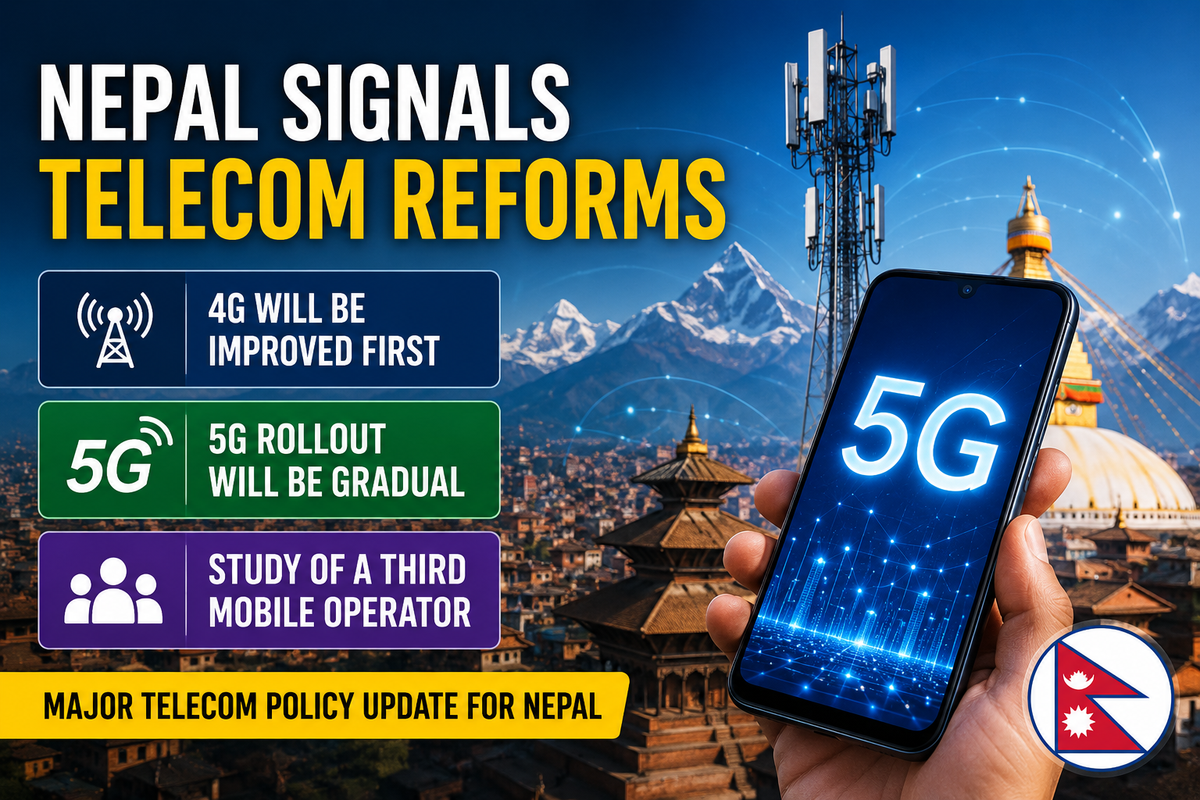
Nepal has signaled a more active telecom policy push, with the government saying it is prioritising reforms in the telecom sector, preparing for a gradual 5G rollout, and studying whether the country needs a third mobile operator. The update came from Communications and Information Technology Minister Bikram Timilsina at a press meet in Kathmandu on May 13.
This is important because it goes beyond another 5G headline. The message from the government is that Nepal is not simply racing to switch on 5G. Instead, it plans to improve 4G first, work on spectrum allocation, examine competition in the market, and look at wider digital infrastructure such as data centres.
What the government said
According to the minister, Nepal is focusing on improving the quality, competitiveness, and management of telecom services. He said 5G will not replace 4G immediately, and that efforts are underway to make 4G more effective while introducing 5G gradually.
He also said preparations have started for spectrum allocation and distribution, with 5G remaining a priority. At the same time, the government is studying whether an additional mobile operator could improve competition in the sector. Regular discussions are reportedly being held with Nepal Telecom and the Nepal Telecommunications Authority.
Another notable point is infrastructure. The ministry said it is also studying data centres and the possibility of developing Nepal as a regional data hub with foreign investment.
Why this matters in Nepal
For most users in Nepal, the biggest takeaway is simple: do not expect 5G to replace 4G overnight. In practical terms, that means mobile users are still more likely to feel the next improvements through better 4G performance, stronger network management, and possibly more competitive pricing before 5G becomes mainstream.
That matters because many people still struggle with inconsistent speeds, congestion, dropped calls, and uneven network quality depending on area and operator. A policy focus on service quality can affect far more users immediately than a limited early 5G launch in a few zones.
The discussion around a third mobile operator also matters. Nepal's market has long been dominated by two major operators. If the government seriously moves ahead with a third operator, or uses that possibility to push reforms, users could eventually benefit from better packages, stronger service pressure, and more innovation. Of course, a study is not the same as a launch, so this should be seen as an early policy signal rather than a confirmed market change.
What it could mean for 5G phones
This update also gives buyers a more realistic picture. If you are in Nepal and considering a 5G phone, the government's own message suggests that 4G will remain the main everyday network for many users in the near term. So a 5G label alone should not be the main reason to upgrade right now.
A better buying question is whether the phone offers a good overall package for Nepal today: solid 4G bands, reliable battery life, decent performance, and long software support. 5G readiness is useful, but it should be treated as future-proofing rather than an immediate daily benefit for most people.
Why data centres are part of the same story
The data centre angle is easy to miss, but it may be one of the more important long-term points. If Nepal wants to grow cloud services, digital businesses, AI workloads, and locally hosted platforms, telecom reform alone is not enough. The country also needs stronger digital infrastructure, more reliable connectivity, and confidence for investment.
A serious push for data centres could have wider effects beyond telecom companies. It could help local startups, media platforms, SaaS businesses, payment services, educational technology platforms, and government digital systems. It also connects to bigger questions around data sovereignty, latency, disaster recovery, and whether more digital services can be hosted closer to Nepali users.
What readers should watch next
This announcement is best treated as a policy direction, not a finished rollout plan. The next things worth watching are:
- Whether the government or NTA announces a clearer 5G spectrum timeline
- Any concrete plan for improving 4G quality and coverage first
- Whether a third operator study turns into a formal proposal or licensing move
- Specific incentives or policy changes for data centres and digital infrastructure
- Any pricing, device compatibility, or pilot area details tied to future 5G deployment
Bottom line
Nepal's latest telecom message is more important than a routine network teaser because it touches policy, competition, infrastructure, and consumer expectations at the same time. The key message for users is clear: 4G still matters most right now, 5G is being prepared gradually, and the government appears to be thinking more seriously about how the telecom market should evolve.
If that leads to better service quality, smarter spectrum policy, and real competition, it could matter to nearly every mobile user in Nepal.
Source: Remarks by Communications and Information Technology Minister Bikram Timilsina reported on May 13, 2026.