
SIM Swap Scams Are a Serious Risk for Nepali Bank and Wallet Users. Here Is How to Protect Yourself and What to Do Fast
As Nepal relies more on OTPs, mobile banking, wallets and digital KYC, control of your phone number has become a financial security issue. This guide explains SIM swap risk in Nepal and the steps users should take before and after an attack.

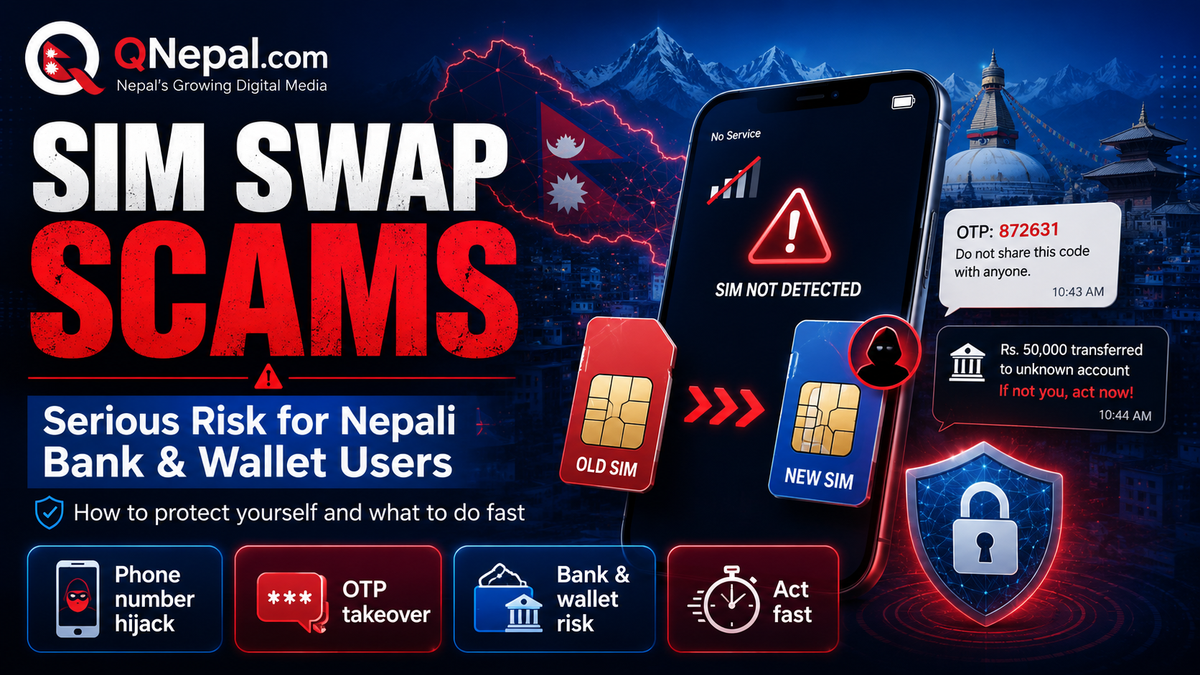
For many people in Nepal, a mobile number is no longer just for calls. It is tied to bank OTPs, wallet logins, password resets, ride apps, ecommerce accounts, social media, and digital identity checks. That means if someone takes control of your SIM, they may also get a path into your money and your accounts.
This is why SIM swap fraud deserves more attention from Nepali users. QNepal has already covered phishing scams hitting bank and wallet customers. But SIM swap risk is a separate gap worth explaining because it targets one of the weakest points in Nepal’s digital life: how much trust still sits on a phone number and one-time passwords.
What is a SIM swap scam?
A SIM swap scam happens when a fraudster gets your phone number transferred to another SIM or eSIM under their control. Once that happens, calls and SMS messages meant for you can start going to the attacker instead. If your bank, wallet, email account or social platform uses SMS-based OTP verification, the criminal may then try to reset passwords or approve transactions.
In simple terms, the attacker is not stealing your phone first. They are trying to steal your number.
Why this matters in Nepal now
This is becoming more important in Nepal for several reasons:
- Digital payments are now routine for bills, QR payments, wallet top-ups and bank transfers.
- SMS OTP is still widely used across banking, wallets and account recovery systems.
- Telecom services are getting more digital, including online SIM and eSIM workflows, which makes strong identity verification even more important.
- Phishing and social engineering are already rising, which gives criminals more ways to collect the personal data needed to attempt SIM-related fraud.
That does not mean Nepal is seeing a visible nationwide SIM swap wave in public reporting every day. But it does mean the risk model fits Nepal very well: growing digital finance, heavy OTP dependence, and users who may not realize that a sudden mobile signal loss can be a financial emergency.
How a SIM swap attack usually works
Different cases vary, but the pattern often looks like this:
- The attacker gathers personal details about you through phishing, leaked documents, social media, fake support calls, or previous scams.
- They try to convince a telecom channel or support workflow that they are you and need a replacement SIM or number transfer.
- Your real SIM suddenly loses service or stops receiving calls and SMS messages.
- The attacker uses your number to receive OTPs, reset account passwords, or confirm sensitive actions.
- They target bank accounts, wallet balances, email inboxes and social accounts before you realize what happened.
In some cases, SIM swapping is combined with phishing. The victim first gives away account data, card details or identity information, and the criminal then uses SIM control to bypass OTP security.
Warning signs Nepali users should not ignore
If any of these happen unexpectedly, treat them seriously:
- your phone suddenly shows no network or loses signal for an unusual period
- you stop receiving calls or OTP SMS messages when others on the same network seem fine
- you receive alerts that a SIM replacement, eSIM activation or account change was requested
- bank or wallet notifications appear for logins, password resets or transactions you did not initiate
- your email or social media accounts suddenly log you out or ask you to re-verify access
A normal network issue can cause some of these symptoms too. The difference is whether they happen alongside account alerts, password reset attempts or financial activity you do not recognize.
How to reduce your risk before anything goes wrong
1. Strengthen the accounts connected to your number
Your mobile number is often only one part of the attack chain. Reduce the damage a criminal can do if they get it.
- Use a strong unique password for email, banking and wallet-linked services.
- Where possible, prefer app-based authentication or extra security controls instead of relying only on SMS OTP.
- Turn on login alerts for your bank, wallet, Google account, Facebook, Instagram and other important services.
- Keep your main email account especially secure, because password resets often go there first.
2. Share less personal data publicly
Fraudsters often build identity profiles from small pieces of information.
- Do not post your phone number, birth date, citizenship details or home address publicly unless necessary.
- Be cautious with photos of official documents, boarding passes, forms and bills.
- Do not trust random calls or messages claiming to be from a bank, wallet, telecom company or government office.
3. Secure your telecom relationship
Ask what protections your operator offers for SIM replacement and eSIM conversion. Even if the process is not standardized across providers, users should push for stronger verification.
- Keep your SIM registration and KYC details accurate.
- Make sure only you control the email address linked to telecom services.
- Watch closely for any message about SIM reissue, eSIM activation or profile changes.
4. Reduce OTP dependence where you can
Nepali users often cannot fully avoid SMS OTP. But they can limit its power.
- Use banking apps with stronger device binding and security controls where available.
- Keep only necessary wallet balances instead of storing more money than needed.
- Separate critical accounts across different recovery methods when possible.
What to do immediately if you think your SIM was swapped
Time matters. If your number is hijacked, the first hour can be critical.
- Call your telecom operator immediately from another number and report suspected unauthorized SIM replacement or eSIM activation.
- Contact your bank and wallet providers right away and request temporary blocking, transaction review or account protection.
- Change your email password first, because email is often the hub for other account resets.
- Change passwords on financial and social accounts from a trusted device.
- Review recent transactions and login alerts across wallets, mobile banking and email.
- Document everything: time of signal loss, screenshots, SMS alerts, account emails and support ticket numbers.
- Report the case to the Cyber Bureau or the relevant police channel if money was stolen or accounts were accessed.
If you still have app access to your bank or wallet before the attacker moves funds, use that small window to freeze cards, block transactions or raise an alert if those options are available.
What banks, wallets and telecom operators in Nepal should improve
This is not only a user-awareness problem. Nepal’s digital ecosystem should also treat phone-number takeover as a structural fraud risk.
Areas that deserve stronger attention include:
- more robust verification before SIM replacement or eSIM activation
- clearer customer alerts for SIM-related account changes
- limits or extra checks on high-risk transactions immediately after SIM changes
- less dependence on SMS OTP as the only gate for sensitive actions
- faster coordination between telecom operators, banks, wallets and law enforcement when suspected takeover cases appear
As Nepal pushes deeper into digital payments and online service delivery, identity assurance at the telecom layer becomes part of financial security.
The bigger point for Nepali readers
Many users think of cybercrime as fake links, cloned Facebook accounts or suspicious QR requests. Those are real risks. But a SIM swap attack is more dangerous in one important way: it can quietly convert your mobile number into a master key for many other systems.
That is why this topic deserves a place in QNepal’s coverage. For Nepali users, protecting a phone number is no longer just a telecom issue. It is now a banking, wallet, privacy and account-safety issue too.
Quick checklist
- Use strong unique passwords for email, banking and wallets
- Turn on login and transaction alerts
- Be suspicious if your phone suddenly loses service without explanation
- React immediately to SIM replacement or eSIM activation messages
- Call your telecom provider, bank and wallet provider fast if you suspect takeover
- Keep records and report financial theft or account abuse to authorities
In Nepal’s digital economy, a stolen phone number can become a stolen identity. Users should treat it that seriously.