
National ID Card Services Resume After 10-Day Disruption, but the Outage Exposed a Bigger Digital Risk for Nepal
The immediate outage may be over, but the disruption showed how deeply Nepal now depends on a few central digital systems for passports, identity verification and public services.

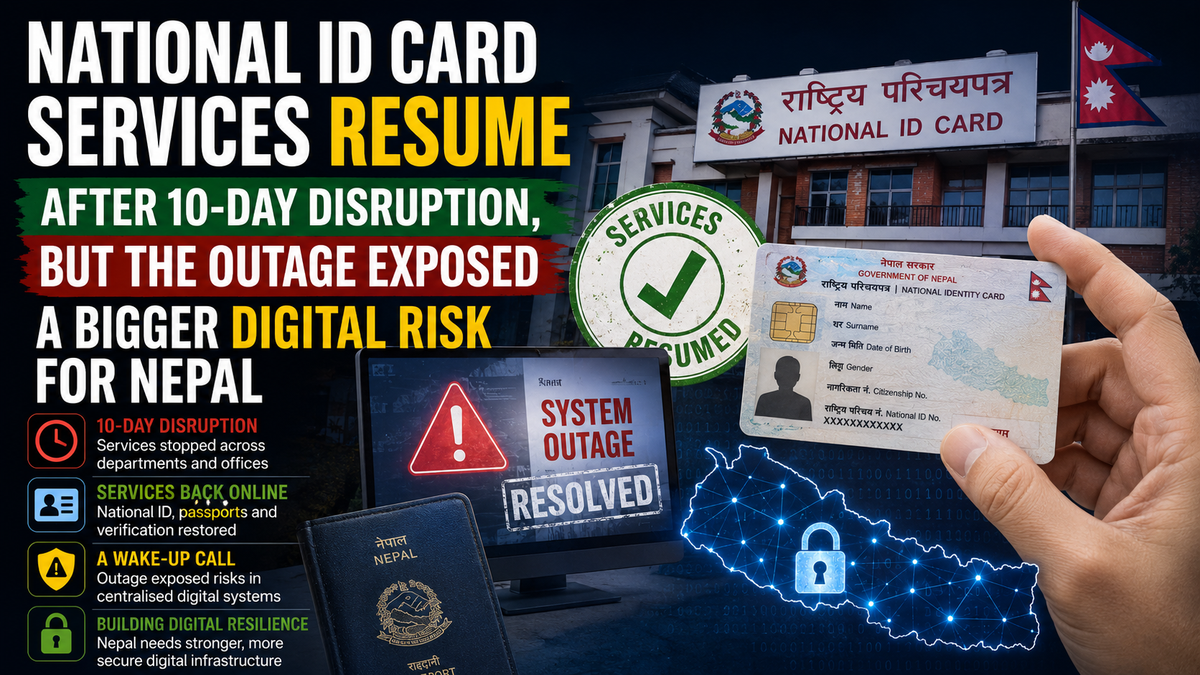
Nepal’s National Identity Card Management Information System has resumed operation after a 10-day disruption, ending a technical breakdown that affected identity-card enrollment, National Identity Number verification and several connected public services. The service restoration is welcome, but the episode also exposed a deeper issue: as Nepal moves more government functions online, failures in one central digital system can quickly ripple across essential services used by thousands of people.
According to TechPana, the National Identity Card and Registration Department said the disruption began on 4 May because of a server malfunction and that services returned to normal on Thursday after the system was restored.
What was affected
This was not a minor back-end glitch. The outage disrupted multiple citizen-facing processes that increasingly depend on identity verification.
- New National ID enrollment was halted.
- National Identity Number verification stopped working.
- Passport-related processing was affected because identity numbers could not be verified.
- Social security allowance renewal and some registration-related services were also reportedly disrupted.
- Correction of personal details and generation of identity numbers during birth registration were impacted as well.
That matters because digital identity is no longer a standalone card project. It is becoming part of the plumbing behind many public services in Nepal.
Why this matters for Nepal
For readers, the key point is not only that services are back. It is that Nepal’s digital public infrastructure is becoming more interconnected, while resilience still appears fragile.
When one identity platform goes down, the impact can spread into passports, welfare-related processes, local registration work and verification tasks that ordinary people may need urgently. A student applying for a passport, a family handling birth registration, or an older citizen renewing benefits may not care what server failed. They only see a public service that suddenly stops.
This is exactly why digital-governance stories matter. Nepal is pushing deeper into online systems, one-time KYC, integrated citizen services and broader e-governance. But the value of digital transformation depends not just on launching platforms. It depends on uptime, backup systems, disaster recovery, transparency and operational readiness.
The larger lesson: centralisation increases the cost of failure
Centralised digital systems can improve efficiency, reduce duplication and make verification faster. But they also create concentration risk. If one key system breaks, the disruption can spread widely unless agencies have fallback procedures and technical redundancy.
The National ID outage should raise several practical questions:
- Did agencies have an effective fallback workflow while the system was down?
- How quickly can critical government databases be restored after failure?
- Are there strong redundancy and disaster-recovery arrangements in place?
- How clearly are citizens informed when a major public digital service breaks?
These are not abstract IT concerns. They affect public trust in Nepal’s broader digital-state ambitions.
What readers should know now
If you delayed identity-card enrollment, passport processing or verification-related work because of the outage, services have reportedly resumed. Even so, it may be wise to confirm status with the relevant office before making a long trip, especially if your work depends on identity-number verification.
The bigger takeaway is that Nepal needs not only more digital public services, but also stronger reliability standards for the systems behind them. A restored server solves the immediate problem. It does not automatically solve the structural one.
As QNepal has noted in earlier coverage of digital governance and public-system risk, Nepal’s next challenge is no longer simply digitising services. It is making sure those services stay dependable when people need them most.