
A Nepal Startup Just Launched Local GPU Infrastructure for AI Builders. That Could Matter More Than Another AI App Announcement
Nepal’s AI conversation often focuses on policy and chatbots. But local GPU infrastructure may be the harder and more important missing layer. A new launch from AnK suggests that gap is starting to get real attention.

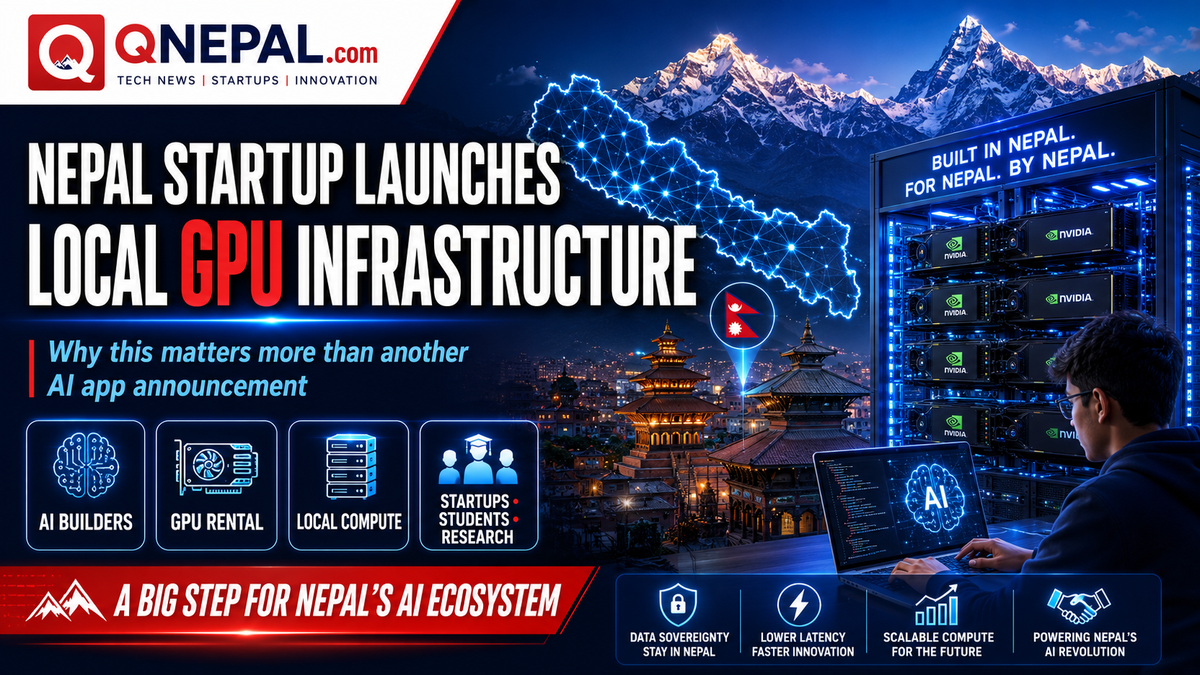
Nepal’s AI debate often jumps quickly to big ideas: national strategy, classroom adoption, government use cases, and the next generation of startups. But one of the most practical bottlenecks has been much simpler: where do Nepali builders actually get serious computing power?
That is why a new move by Nepal-based startup AnK (Accelerated Komputing) matters. The company says it has launched a local GPU infrastructure rental platform aimed at AI startups, students, researchers and engineering teams that need high-performance computing without buying expensive hardware outright.
According to reporting by Techpana, the company has set up a computing facility in Sipadol, Suryabinayak, Bhaktapur and is allowing users to remotely access GPU systems for AI model training, engineering simulation and other compute-heavy work.
Why this matters in Nepal
This is more important than a routine startup announcement because compute access is one of the real foundations of an AI ecosystem. Nepal can talk about AI policy, digital skills and innovation all it wants, but startups and students still hit the same hard constraint when they try to build something serious: GPUs are expensive, imported hardware is difficult to scale, power and cooling are not trivial, and relying fully on foreign cloud infrastructure can be costly.
A local rentable option does not solve every problem. But it could help reduce one of the biggest entry barriers for teams that want to:
- train or fine-tune AI models
- run data science and research workloads
- test engineering and simulation projects
- prototype products before spending heavily on infrastructure
For Nepali students and early-stage startups, that matters because the cost of experimentation is often the difference between an idea that stays on paper and one that becomes a product.
What AnK says it has built
Techpana reports that AnK currently operates 19 high-performance systems in Nepal. The reported setup includes RTX 5090, RTX 5080 and RTX 3090 GPU-based machines, along with supporting power, cooling and storage infrastructure. The company also reportedly has additional infrastructure in Japan for larger-scale workloads.
The platform is being offered as an infrastructure-as-a-service model, meaning users can rent computing resources remotely instead of purchasing and managing them themselves. That model is especially relevant in Nepal, where even technically capable teams often lack the capital to assemble large GPU clusters on their own.
The company says users can access the systems through dedicated virtual machines from ordinary laptops, which could make the service more practical for university researchers, startup teams and distributed engineering groups.
The bigger AI gap Nepal still needs to close
This launch does not mean Nepal suddenly has abundant AI infrastructure. Far from it. But it highlights a deeper truth: AI readiness is not just about apps and policy documents. It is also about compute, data, electricity, cooling, connectivity and sustainable operating cost.
That broader point matters even more now because Nepal has recently been discussing new AI policy structures, data centers and digital infrastructure plans. If those ambitions are to mean anything in practice, the country will need more than enthusiasm. It will need actual technical capacity that builders inside Nepal can use.
In that sense, local GPU availability matters for at least three reasons:
- Startups may be able to prototype faster without moving everything offshore
- Students and researchers may get more hands-on access to serious compute tools
- Nepal’s AI ecosystem can begin building some capacity locally instead of depending entirely on external platforms
Why readers should watch this space
For ordinary readers, GPU infrastructure may sound too niche. But if Nepal wants stronger AI startups, better technical education, more exportable digital products and higher-value R&D work, this kind of infrastructure is part of the pipeline.
The key question now is whether this remains a small specialist service or becomes the start of a broader shift toward locally available AI compute in Nepal. If more companies, universities or public institutions follow with similar investments, Nepal’s AI conversation could move from mostly aspirational to more operational.
That is why this story deserves attention. It is not flashy in the way a new chatbot or phone launch is. But it touches something more fundamental: whether Nepal’s AI builders can actually afford to build from Nepal.
Source: Techpana reporting on AnK’s newly launched GPU infrastructure platform for AI startups, students and researchers in Nepal.