
Nepal Internet Providers Comparison (2026 Guide)
This guide compares the main home internet providers in Nepal in 2026, with speed, pricing, coverage, and who each plan fits best.

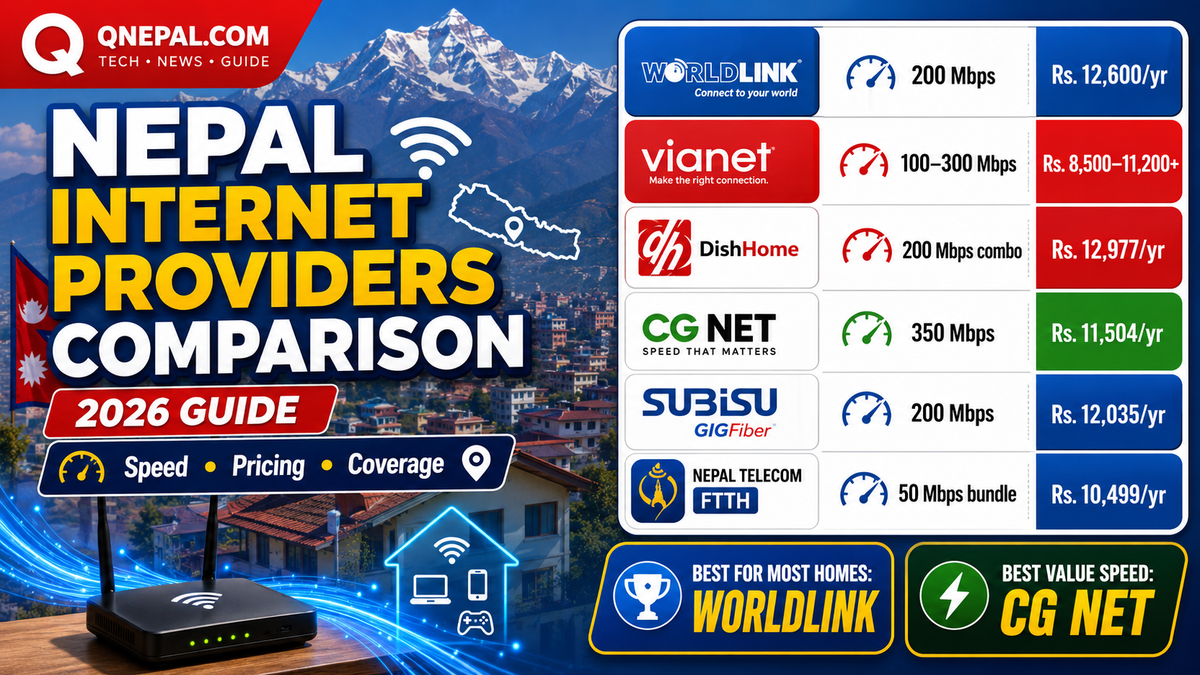
The best internet provider in Nepal for most homes in 2026 is WorldLink if your area gets stable service and you want broad coverage, common availability, and a simple 200 Mbps yearly plan around Rs. 12,600. Vianet is a strong pick if you want higher-end fiber options and faster premium tiers. DishHome often makes sense for families who want internet and TV in one bundle. CG Net stands out on raw price-per-speed. Nepal Telecom FTTH matters if you want a state-owned option or better fit in areas where private fiber is weak.
This guide is for people in Nepal who are choosing a new home internet connection, switching from a weak ISP, or comparing yearly renewal costs before paying again.
Key Takeaways
- WorldLink’s common 200 Mbps yearly plan is listed around Rs. 12,600 and stays one of the easiest default picks for many homes.
- Vianet lists 100 Mbps at about Rs. 8,500, 200 Mbps at about Rs. 11,200, and 300 Mbps on higher tiers, so it is a strong choice if you want faster premium options.
- DishHome’s 200 Mbps yearly combo listing appears around Rs. 12,977, which makes sense if your household also wants TV service in one bill.
- CG Net’s residential pricing highlights 350 Mbps at around Rs. 11,504 for 12 months, which looks strong on value if your area gets reliable support.
- Subisu’s 200 Mbps yearly renewal is listed near Rs. 12,035, while Nepal Telecom FTTH has a 50 Mbps yearly package around Rs. 10,499 with NTTV and calling bundles.
- The right ISP in Nepal depends less on headline speed and more on area coverage, support quality, router setup, uptime, and how many people share the line at your home.
Table of Contents
- Why choosing an ISP in Nepal is hard
- Quick comparison table
- WorldLink
- Vianet
- DishHome Fibernet
- CG Net
- Subisu
- Nepal Telecom FTTH
- How to choose the right ISP
- Before you switch providers
- FAQ
- Final verdict
Why choosing an ISP in Nepal is hard
Buying internet in Nepal is not only about the highest Mbps number on a poster. Two homes in the same city often get different results from the same provider. One line stays stable for Zoom calls and YouTube all day. Another line drops every night, even with the same package.
The main reasons are simple.
- Coverage differs by neighborhood, building type, and nearby distribution boxes.
- Old routers make a fast plan feel slow.
- Support quality varies by branch and local technician response.
- Bundles with TV or mesh routers change the real cost.
- Some homes do fine on 100 Mbps, while others need 200 Mbps or more because of many devices.
So the better question is not, “Which ISP is fastest in Nepal?” The better question is, “Which ISP is the best fit for your location, budget, and daily use?”
Quick comparison table
| Provider | Public plan reference | Approx yearly price | Best for | Main caution |
|---|---|---|---|---|
| WorldLink | 200 Mbps | Rs. 12,600 | Most homes, wide availability | Area experience varies |
| Vianet | 100 Mbps, 200 Mbps, 300 Mbps | Rs. 8,500 to Rs. 11,200 and up | Users who want premium fiber tiers | Check actual local support before paying yearly |
| DishHome | 200 Mbps combo | Rs. 12,977 | Families who want internet plus TV | Bundles make comparisons less clean |
| CG Net | 350 Mbps | Rs. 11,504 | Speed-per-rupee buyers | Ask neighbors about uptime first |
| Subisu | 200 Mbps renew plan | Rs. 12,035 | Homes already happy with Subisu network | Value depends on area and included extras |
| Nepal Telecom FTTH | 50 Mbps bundle | Rs. 10,499 | Areas with limited private fiber options | Lower entry speed than some rivals |
Prices above are based on public plan listings and search-visible tariff pages checked for this guide. In Nepal, ISP plans change often. Installation fees, deposit, TV bundle terms, router rental, and renewal offers also change. Always confirm the final payable amount before ordering.
WorldLink
WorldLink stays one of the most important internet providers in Nepal because of scale, brand recognition, and broad residential reach. For many households, WorldLink is the first provider available in the area, and that matters because practical availability beats theoretical value.
A commonly visible residential listing shows 200 Mbps for 12 months at around Rs. 12,600. On paper, that makes WorldLink a safe middle-ground pick. You are not choosing the cheapest provider, but you are choosing one with large reach, common installer presence, and many users across Nepal.
Why WorldLink makes sense
- Easy to find in many urban and semi-urban areas.
- Common benchmark provider, so neighbors usually have real feedback.
- 200 Mbps is enough for most homes with phones, TV streaming, school use, and office work.
- Often packaged with extra services and home Wi-Fi options.
Watch out for
- Real experience depends heavily on your area.
- You still need to check whether one router covers your entire flat or house.
- Some buyers pay for speed upgrades when the real issue is weak indoor Wi-Fi, not weak fiber.
Best for: Most homes who want a mainstream provider with broad availability and fewer surprises.
Vianet
Vianet is a strong option if you care about fiber branding, premium plans, and faster top-end tiers. Public listings show around Rs. 8,500 for 100 Mbps, around Rs. 11,200 for 200 Mbps, and higher packages moving into 300 Mbps and above.
Vianet also stands out because it pushes higher-end plans more aggressively than many buyers need. That is good if your home has many users, heavy streaming, cloud backup, or large downloads. It is less useful if your main use is YouTube, Facebook, and normal office work.
Why Vianet makes sense
- Clear tier structure from entry to premium plans.
- Good fit for users who want more than a basic package.
- Appeals to buyers looking at future upgrades, Wi-Fi 6, or multi-gig branding.
Watch out for
- Do not overpay for a faster package if your home only uses a few devices.
- Ask how much of the final bill is plan cost versus bundle cost.
- Check support reputation in your exact neighborhood.
Best for: Homes with many devices, gamers, remote workers, and buyers who want room to upgrade.
DishHome Fibernet
DishHome is worth considering if your household already pays for TV and wants one bundled setup. Public listings show a 200 Mbps package around Rs. 12,977 for 12 months in combo form. The core value here is not only internet speed. The value is one provider, one installation process, and one household entertainment package.
This makes DishHome easier to justify for families than for solo users. If you do not care about TV, the comparison becomes less clean because bundle extras raise the visible price.
Why DishHome makes sense
- Good household bundle logic for TV plus internet.
- Simple option for families who want fewer separate bills.
- Competitive enough in the mainstream home segment.
Watch out for
- Bundle pricing is harder to compare line by line with internet-only plans.
- You should check whether your quoted plan includes TV charges, router charges, or both.
Best for: Family homes where TV still matters.
CG Net
CG Net keeps attracting attention because the speed-per-price math looks strong. Public residential references show a 350 Mbps yearly plan around Rs. 11,504. Numbers like that make buyers stop and compare.
If your area has solid CG Net service and responsive support, the value can look better than some older mainstream plans. But with internet in Nepal, cheap speed is only a good deal if the line stays stable during evening hours and when support is needed.
Why CG Net makes sense
- Strong visible value on Mbps per rupee.
- Appeals to speed-focused buyers.
- Good option for users who compare plans aggressively before renewing.
Watch out for
- Ask neighbors first. This matters more here than ad copy.
- Confirm any deposit, install, or equipment terms before paying.
- Raw speed on paper does not guarantee low downtime.
Best for: Buyers who want the strongest visible price-to-speed ratio and have good local area feedback.
Subisu
Subisu still matters in Nepal’s home internet market, especially in places where the provider already has a long presence and stable local infrastructure. A public renew page shows 200 Mbps for about Rs. 12,035 for 12 months.
Subisu is often not the loudest marketing choice, but it stays relevant because many households already know the brand and already use related services. If your building or neighborhood has a stable Subisu setup, switching away is not always necessary.
Why Subisu makes sense
- Established name with existing user base.
- Mid-range yearly price stays competitive enough.
- Reasonable pick if local performance is already proven.
Watch out for
- Compare included features, not only the list price.
- Do not assume a known brand means the best value in every location.
Best for: Existing Subisu households and homes in areas where service has been stable for years.
Nepal Telecom FTTH
Nepal Telecom FTTH deserves more attention than many urban buyers give it. A public tariff page shows a 50 Mbps yearly bundle around Rs. 10,499 with NTTV channels and NT-to-NT calling minutes. The headline speed looks lower than some private rivals, but the value depends on area coverage and your needs.
In some places, Nepal Telecom is not the fastest-looking option. In other places, it is the most practical one because the private provider you want is not available or has weak support. If your usage is modest, 50 Mbps is enough for streaming, browsing, office work, and school tasks in a smaller household.
Why NT Fiber makes sense
- Relevant in areas where private fiber options are limited.
- Bundle model adds TV and calling value for some homes.
- State-owned provider appeals to users who want a familiar national operator.
Watch out for
- Entry-level speed looks weaker next to private fiber ads.
- Availability and service experience vary by office and location.
Best for: Smaller households, budget-aware users, and areas with fewer private fiber choices.
How to choose the right ISP in Nepal
Use this checklist before you pay for any yearly plan.
1. Ask three nearby users
Do not rely on one friend from another part of town. Ask three people in your own building, lane, or chowk. Evening speed and downtime are local issues.
2. Count your real devices
A home with two phones and one TV does not need the same plan as a flat with six phones, two laptops, a smart TV, and constant video calls.
3. Separate internet speed from Wi-Fi coverage
Many homes think the ISP is slow when the real issue is one cheap router in the far corner of the house. A mesh unit or better router often fixes dead zones better than a bigger Mbps plan.
4. Check support response time
The internet feels great when it works. The real test is what happens when your line fails at 8 pm. Ask users how fast local technicians respond.
5. Compare total bill, not sticker price
Ask for final payable amount. Include VAT, router rental, TV bundle cost, deposit, installation, and renewal terms.
6. Match the plan to your use
- 50 to 100 Mbps: smaller households, light streaming, general browsing.
- 200 Mbps: most family homes, remote work, school use, multiple devices.
- 300 Mbps and above: heavier downloads, many active users, gamers, creator households.
Before you switch providers
- Test your current setup first. If one room is slow, move closer to the router and compare results.
- Check whether your current provider offers a router upgrade or mesh add-on.
- Ask the new ISP for area availability, installation timeline, and refund rules.
- Keep screenshots of the quoted plan and full payment breakdown.
- If you work from home, avoid switching on a day with deadlines or live meetings.
Frequently Asked Questions
Which is the best internet provider in Nepal in 2026?
For most households, WorldLink stays the safest default choice because of broad availability and a common 200 Mbps yearly plan around Rs. 12,600. The best local option still depends on your area.
Which ISP gives the best value in Nepal?
CG Net looks strong on raw speed-per-price, with public references showing 350 Mbps around Rs. 11,504 yearly. Value only holds if service in your area is stable.
Is 100 Mbps enough for a home in Nepal?
Yes, for many smaller homes. If your family has many devices, 200 Mbps is often the more comfortable long-term pick.
Is Nepal Telecom FTTH worth it?
Yes, especially where private fiber choices are weak or unavailable. Its lower entry speed still works for many normal households.
Should you buy a TV bundle with internet?
Only if your household still uses TV often. If not, internet-only plans are usually easier to compare and easier to keep cheap.
What matters more, speed or support?
Support matters more once your plan reaches a decent baseline. A stable 100 or 200 Mbps line with fast technician response is better than a higher-speed line with frequent outages.
Final Verdict
If you want the simplest mainstream answer, start with WorldLink. If you want higher-end fiber tiers and upgrade room, look at Vianet. If you want one family bundle for TV and internet, DishHome is worth a hard look. If you care most about speed-per-rupee, compare CG Net first. If your area already gets stable Subisu service, staying put might be smarter than switching. If private fiber in your area is weak, Nepal Telecom FTTH still deserves serious consideration.
The smartest move in Nepal is not picking the loudest ad. It is checking local availability, real user feedback, and the final yearly bill before you pay.
Written by the QNepal team. Prices and public plan references were checked in May 2026 and should be confirmed with each provider before purchase.