
Nepal’s e-GP Hacking Case Shows Why Public Digital Systems Need Stronger Security
The alleged manipulation of Nepal’s e-GP system is bigger than a court case. It is a warning about how vulnerable high-value public digital systems can become when security, oversight, and accountability lag behind digitisation.

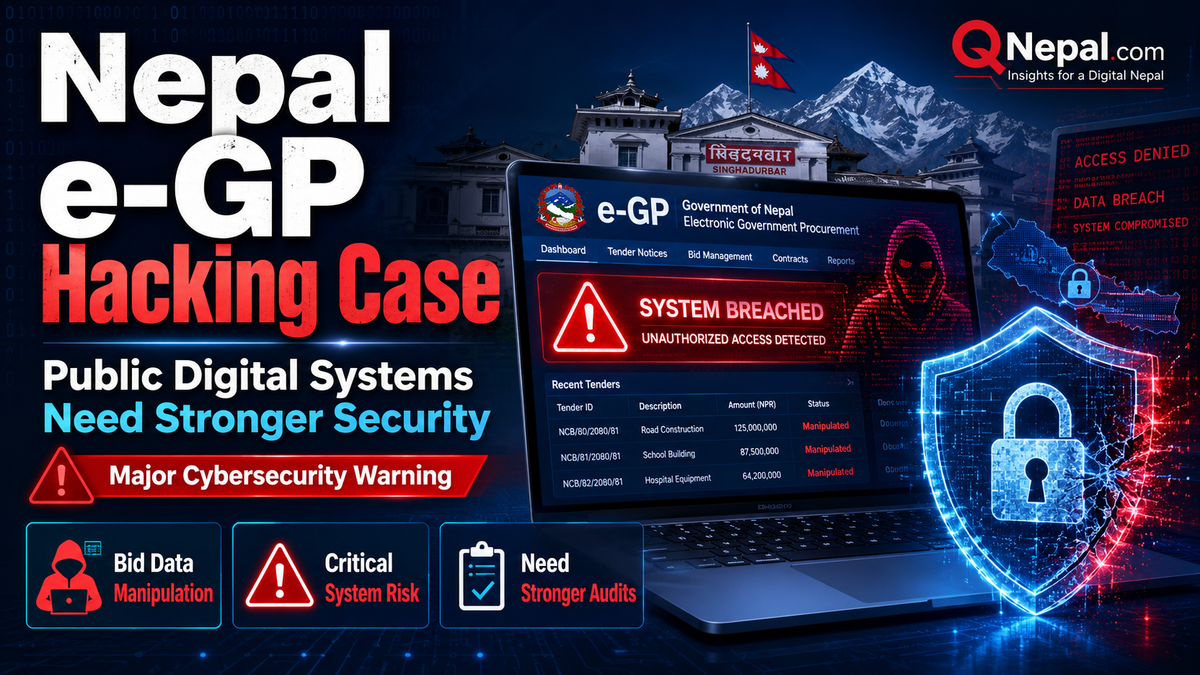
Nepal’s latest e-GP hacking case is not just another crime story. It is one of the clearest warnings yet that the country’s most important public digital systems can become high-risk targets when cybersecurity, audit controls, and procurement oversight do not keep pace with digitisation.
According to reporting on the case, Nepal Police say unauthorized access was used to manipulate parts of the Public Procurement Monitoring Office’s electronic Government Procurement system, including bid-related data after submission deadlines had already closed. A charge sheet has now been filed, and the list of defendants reportedly includes government-linked actors, contractors, intermediaries, and former minister Bikram Pandey, who has denied involvement.
For Nepali readers, the core issue is bigger than any one name in the case. If a public procurement platform handling contracts worth billions of rupees can allegedly be tampered with, the consequences go far beyond IT. It affects trust in government systems, fair competition for businesses, public spending, and confidence in Nepal’s wider digital transformation.
What happened
Investigators say the case surfaced after suspicious activity was detected on infrastructure connected to the e-GP system. The allegations include unauthorized remote access, privilege escalation inside databases, and changes to financial proposal data after bids should have been locked.
Police reporting also points to the use of fake identity channels, including email and WhatsApp, to approach contractors with claims that bid rankings could be changed in exchange for money. Bitcoin and cross-border transfers were allegedly used to avoid normal banking visibility.
The case has now moved into the legal phase, but even before the court reaches conclusions, the public-interest lesson is already clear: digital procurement systems are now critical national infrastructure.
Why this matters in Nepal
Nepal is pushing more services online, from telecom reforms and digital payments to land records, public administration, education systems, and government platforms. That shift is necessary. But the e-GP case shows that putting services online is only the first step. Security architecture, logging, access controls, vendor oversight, insider-risk monitoring, and independent audits matter just as much.
Public procurement is especially sensitive because it combines money, competition, and state power. If bidders believe tenders can be manipulated after submission, smaller firms may lose trust in the system, honest businesses may be discouraged from participating, and the public may question whether digital governance is actually making processes cleaner.
There is also a wider cybersecurity lesson here. Nepal often discusses digital transformation as a speed problem: how fast services can move online. This case shows it is also a resilience problem: whether systems can withstand insider abuse, stolen access, weak server controls, or compromised vendor environments.
What should improve now
First, high-value government platforms should face stronger security review requirements, not only during launch but throughout their lifecycle. Systems linked to contracts, payments, tax, land, identity, or citizen records should be treated as continuously monitored infrastructure.
Second, Nepal needs clearer public expectations around auditability. Sensitive procurement systems should have tamper-evident logging, stricter separation of duties, mandatory access reviews, and alerting when changes happen outside normal workflows.
Third, third-party vendors and cloud environments need tighter governance. If surrounding infrastructure becomes the weak point, the whole system can be exposed. Procurement for digital systems should weigh secure design and ongoing security operations, not only lowest upfront cost.
Fourth, this is a reminder that cryptocurrency-related investigations are now part of real cybercrime enforcement in Nepal. Businesses and institutions should not assume that digital payment trails are invisible.
What readers and businesses should take away
If you are a contractor, startup, or company working with public digital platforms in Nepal, this case is a signal to document everything, verify official communication channels carefully, and treat unusual payment or bid-change approaches as red flags.
If you are a regular citizen, the main takeaway is that cybersecurity failures in government systems are not abstract technical issues. They can influence how public money is spent, how fairly contracts are awarded, and how much trust people place in online public services.
Nepal should not slow down digitisation because of cases like this. It should take them as proof that stronger digital governance is now urgent. The goal is not just to build more online systems, but to build systems people can trust when the stakes are high.
Bottom line: the e-GP hacking case matters because it sits at the intersection of cybersecurity, corruption risk, public spending, and digital trust. For Nepal’s digital future, that makes it one of the most important tech stories of the moment.