
Nepal’s New Digital Governance Plan Could Bring One-Time KYC, Online SIM Services and Faster Citizen App Integration
A new government action plan could make some everyday digital services in Nepal less frustrating, from SIM ownership transfers and lost SIM recovery to Citizen App integration and one-time KYC.

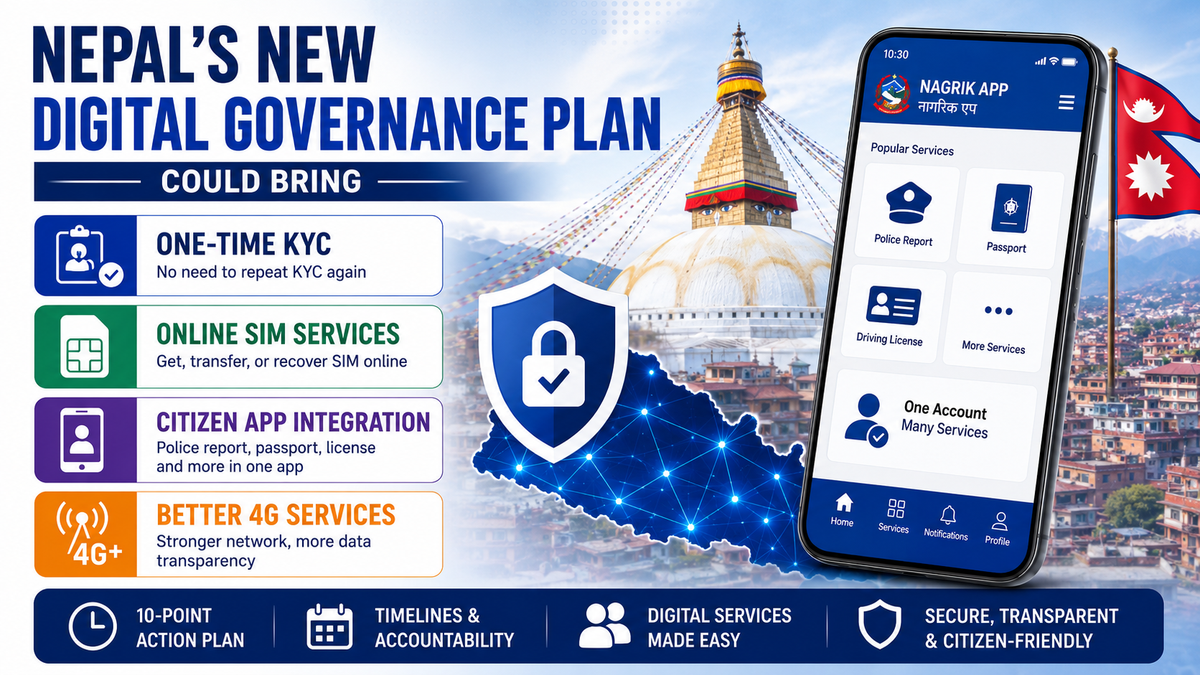
Nepal has approved a new digital-governance action plan that could affect millions of mobile users and public-service users if it is implemented on time. The Ministry of Communications and Information Technology says the plan includes one-time KYC for Nepal Telecom users, fully online SIM-related services, tighter 4G service measures, and faster integration of key government services inside the Citizen App.
For readers in Nepal, this matters because it is not just another policy statement about future technology. It targets specific day-to-day frustrations people already face: repeating the same KYC process, visiting offices for SIM changes, dealing with lost SIM recovery, waiting on fragmented government services, and struggling with weak mobile data service.
What the plan says
According to reporting by myRepublica, the ministry has approved a 10-point reform action plan tied to timelines and responsible agencies. The stated goal is to make public services more citizen-friendly, transparent, and digitally accessible.
Some of the most practical tech-related commitments are:
- One-time KYC for Nepal Telecom services: users would not need to repeatedly submit the same identity information once it is already on record.
- Online SIM services within 30 days: distribution, ownership transfer, complaint handling, and lost SIM retrieval are supposed to move fully online.
- Citizen App integration within 45 days: key services including police reports, passports, and driving-license related processes are meant to be integrated more tightly through the Nagrik App.
- 4G policy changes within 30 days: the government says it will amend policy arrangements and provide additional frequencies to improve 4G quality.
- Data-usage transparency: customers are supposed to get notifications after using 90 percent of their mobile data, along with clearer pay-as-you-go and subscription options.
- New digital laws within 90 days: bills related to IT, digital governance, cybersecurity, data protection, and AI are also part of the plan.
Why this matters in Nepal
This is important because Nepal’s digital experience often breaks down not at the level of apps and platforms, but at the level of process. A user may already have a SIM, citizenship details, and prior records in one system, yet still be forced to visit a counter, fill out forms again, or wait for manual verification in another office.
If one-time KYC works properly, it could reduce repeat paperwork and make telecom services easier to manage. If online SIM services actually go live, that could save time for students, migrant families, remote users, and people outside major city centres who currently depend on physical visits for simple account changes.
The Citizen App part also matters. Nepal has spent years talking about digital public services, but users still face a scattered experience across ministries and offices. Better integration of police reports, passports, and licence-related services would be a meaningful practical upgrade if it reduces in-person visits and processing delays.
The telecom angle is bigger than convenience
The plan also signals that the government understands mobile service quality remains a live issue. Extra spectrum, updated 4G policy arrangements, and mandatory usage alerts may sound technical, but they affect everyday user experience. In Nepal, where mobile internet is often the main internet connection, even small service-quality improvements matter for education, work, banking, and communication.
The proposal for data-use alerts after 90 percent consumption is especially relevant because many users run out of data unexpectedly or get confused by automatic charging under pay-as-you-go settings.
The real question is execution
The biggest caution is simple: Nepal has announced many digital-service improvements before, and implementation has often lagged behind the headline. Timelines such as 30, 45, and 90 days are useful because they make the promises measurable. But readers should treat the plan as a meaningful policy move, not a finished result.
What matters next is whether Nepal Telecom, the Nepal Telecommunications Authority, and the related ministries actually deliver online workflows that are reliable, secure, and easy to use.
What readers should watch next
- Whether Nepal Telecom formally launches one-time KYC and explains how existing user records will be handled
- Whether online SIM ownership transfer and lost-SIM recovery become available without branch visits
- Whether the Nagrik App adds smoother licence, passport, and police-report workflows
- Whether 4G quality improves in practice, not just on paper
- Whether the promised cybersecurity, data-protection, and AI bills are actually tabled
If even part of this plan is implemented properly, it could make Nepal’s digital public services feel more joined-up and less bureaucratic. That is why this story deserves attention beyond a single ministry announcement.