
Why Nepal’s Communications Ministry Using Gmail Is More Than Just a Bad Look
When the ministry responsible for ICT policy uses Gmail instead of a government domain, the issue is not cosmetic. It raises practical questions about security, records, trust and digital governance in Nepal.

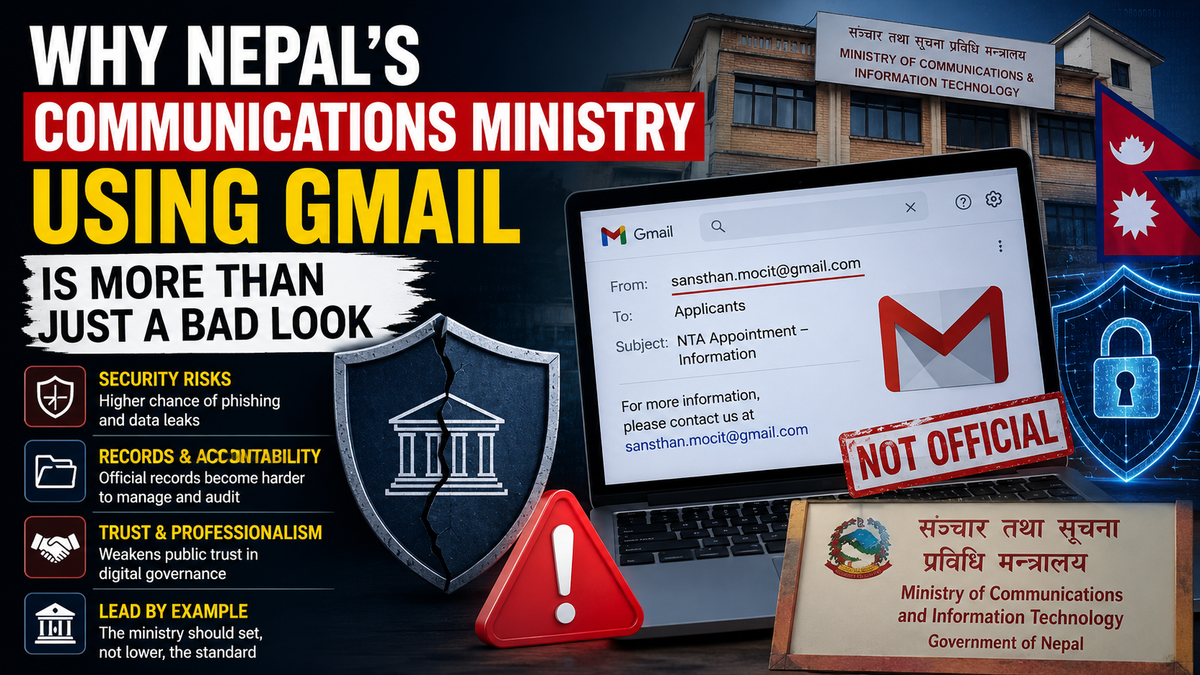
Nepal’s Ministry of Communications and Information Technology has come under scrutiny after an official notice related to Nepal Telecommunications Authority appointments asked people to use a Gmail address for inquiries instead of an official @nepal.gov.np account. On the surface, that may look like a small administrative shortcut. In practice, it raises bigger questions about cybersecurity discipline, institutional trust, and whether the government is following the same digital-governance standards it expects others to respect.
For QNepal readers, this matters because the ministry is not just another office. It is the state body tied to communications policy, digital systems, telecom regulation, and broader ICT governance. If even this ministry falls back on consumer email for official work, it weakens confidence in how seriously digital security and recordkeeping are being handled across government.
What happened
According to Techpana, the issue surfaced after the ministry published a notice on 9 May 2026 calling for applications for the posts of chairperson and members of the Nepal Telecommunications Authority. In that notice, applicants were reportedly told to contact sansthan.mocit@gmail.com for more information.
That stands out because Nepal already has an official government email system using the @nepal.gov.np domain. The Department of Information Technology, which operates under the same ministry, oversees that centralized system. So the problem is not simply that an office needed email access. The problem is that the ministry appears to have bypassed its own official channel.
Why this is a real cybersecurity issue
Using Gmail does not automatically mean a message is unsafe. But for official government communication, it creates several avoidable risks.
- Phishing and impersonation risk: Public users may find it harder to distinguish legitimate notices from fake ones when official communication comes from a free email service instead of a government domain.
- Weaker institutional control: Official email systems can be managed, audited, transferred between staff, and secured under government policy. Personal or semi-personal email accounts are harder to control over time.
- Data-sovereignty concerns: Sensitive correspondence handled through foreign-hosted public email services may raise questions about jurisdiction, storage, and long-term access.
- Recordkeeping problems: When employees are transferred, retire, or lose access, important institutional communication can become fragmented or difficult to retrieve.
In other words, this is not just about whether Gmail is convenient. It is about whether official state communication is happening in a way that supports accountability, continuity, and public trust.
Why this matters in Nepal right now
The timing makes the issue more important. Nepal is pushing more public services online, talking more about digital governance reform, and dealing with rising cybersecurity concerns across both public and private systems. QNepal has already covered phishing risks affecting Nepali users and the pressure on public digital infrastructure after major security incidents. In that environment, government offices should be setting a higher standard, not creating extra ambiguity around official communication.
This also matters because the notice was tied to appointments at the Nepal Telecommunications Authority, one of the country’s most important digital-sector regulators. A process related to telecom oversight should be especially careful about formal, verifiable, and professionally managed communication channels.
The bigger governance signal
The deeper concern is cultural, not just technical. If ministries continue to rely on ad hoc digital habits, then Nepal’s digital-governance push risks becoming uneven: modern policy language on paper, but inconsistent operational practice in reality.
That gap matters for citizens, startups, banks, telecom operators, and platform users alike. Digital trust is built not only through new policies and apps, but through everyday administrative discipline. Official domains, secure workflows, auditable communication, and clear ownership of records are part of that foundation.
What should happen next
At minimum, the ministry should clarify why a Gmail account was used, whether official domain-based alternatives were unavailable, and what safeguards were in place. More broadly, Nepal needs stronger enforcement of basic digital-governance hygiene across public bodies, especially those responsible for ICT, telecom, data, and citizen-facing online services.
This may not be the biggest tech story in Nepal this month. But it is exactly the kind of warning sign worth taking seriously. When the ministry responsible for digital policy uses the wrong channel for official communication, the issue is not appearance alone. It is a test of whether Nepal’s digital-state ambitions are being matched by everyday security practice.
Source: Techpana reporting on the Ministry of Communications and Information Technology’s use of Gmail in an official notice related to NTA appointments.