
Nepal’s New AI Policy Is Not Just a Vision Document Anymore. It Now Has Timelines, New Institutions and a Data Center Plan
Nepal’s AI policy has moved beyond broad promises. The new action plan gives it timelines, institutions and infrastructure goals that could shape startups, regulation, education and digital services.

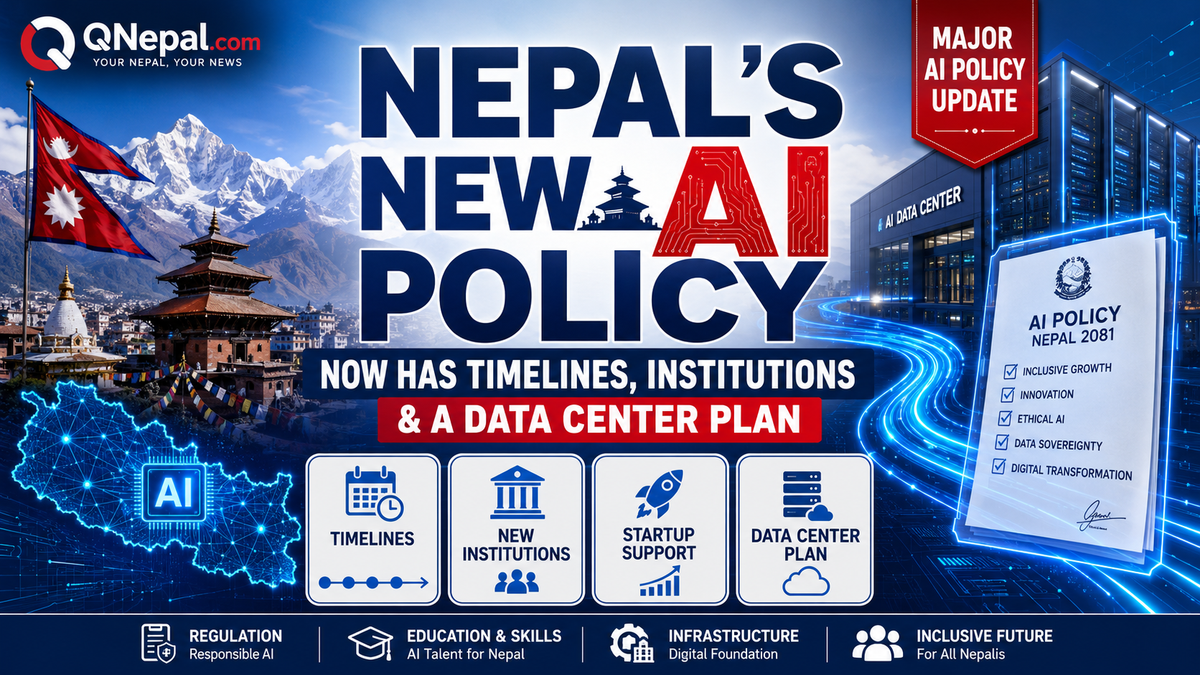
Nepal’s newly approved National AI Policy is becoming more than a high-level government promise. According to recent reporting on the policy and its implementation roadmap, the government has now attached specific timelines, new institutions, legal work, startup support mechanisms and infrastructure plans to its AI agenda.
That makes this one of the most important Nepal tech-policy developments right now. The story is not simply that Nepal wants AI. Many countries say that. The bigger question is whether Nepal is beginning to define how AI will be governed, where capacity will be built, and which public systems, businesses and students may be affected first.
What the policy now sets in motion
The approved policy proposes an AI Regulatory Council to help set standards and oversee regulation, a National AI Center under the government to coordinate and promote AI work, and AI Excellence Centers linked to universities and research institutions.
More importantly, the reported action plan puts timelines on some of those ideas. It says three new structures — the AI Regulatory Council, National AI Center and National AI Excellence Center — are to be formed within the next few months.
The roadmap also says Nepal will work on new AI-related laws within two years. These are expected to cover issues such as data security, ownership, exchange, confidentiality and protection of personal and institutional data. Existing laws and guidelines are also expected to be reviewed and updated so they are more compatible with AI-era needs.
Why this matters in Nepal
This matters because AI policy in Nepal is not only about chatbots or classroom curiosity. It could influence how the country handles digital sovereignty, data governance, startup financing, education, cloud infrastructure, internet expansion and public-service modernization.
For Nepali readers, there are at least five practical reasons to pay attention:
- Rules are coming: if Nepal follows through, AI use in government, business and education will increasingly be shaped by formal standards and legal obligations rather than ad hoc experimentation.
- Infrastructure may get a push: the policy links AI growth to better connectivity, data centers, cloud systems and broader digital capacity.
- Startups could see new support: the action plan mentions tools such as venture capital, crowdfunding, incubation support and a regulatory sandbox.
- Students and workers may be affected: AI subjects are expected to enter education systems more directly, while reskilling programs are discussed to address job disruption risks.
- Public services may change: health, energy, transport and other sectors are named as potential areas for AI deployment.
The data center and infrastructure angle is especially important
One of the more notable parts of the reported implementation roadmap is its emphasis on digital infrastructure. The plan says investment processes for AI-related infrastructure will be simplified and that green data centers are to be developed, including in Nepal’s high-hill and Himalayan regions, with support from bodies such as the Investment Board, Nepal Telecommunications Authority and Nepal Electricity Authority.
That is ambitious, and it should be read carefully. Building internationally competitive data-center capacity in Nepal is not a small task. It raises obvious questions about power reliability, fiber connectivity, cooling economics, regulation, capital costs and execution capacity. But the fact that infrastructure is being written into the policy agenda matters because it shows the government is not framing AI only as a software trend. It is treating it as a broader national digital-capacity issue.
What else is in the roadmap
Based on published details, the implementation plan also includes:
- AI standards within a year for data, algorithms and technology use
- curriculum and certification work through schools, universities and education bodies
- reskilling programs to respond to possible job displacement from AI adoption
- AI incubation hubs to support startups and innovation
- sector-specific use cases in health, energy, transportation and tourism
- support for local-language AI and research collaboration
Those are significant because they move the conversation away from generic AI excitement and toward concrete state capacity questions: who builds, who regulates, who pays, who benefits, and how misuse will be contained.
The real challenge is implementation
Nepal has announced many ambitious digital plans before. The reason this story matters now is not because success is guaranteed, but because the policy has crossed an important threshold: it has moved from a draft vision toward a structured implementation framework.
That said, the hard part starts now. Institutions have to be created. Laws have to be drafted. Technical standards have to be meaningful. Universities need resources, not just policy language. Startups need access to capital and computing resources. Data protection cannot remain vague if the state wants public trust.
In other words, Nepal’s AI policy deserves attention precisely because it could become either a serious foundation for long-term digital capability or another ambitious document weakened by slow execution.
What QNepal readers should watch next
The next signals that will matter most are practical ones: whether the proposed AI bodies are actually formed on time, whether draft laws appear, whether budget and institutional ownership become clearer, and whether infrastructure promises such as data centers and AI incubation support move beyond announcements.
If those steps begin to materialize, Nepal’s AI policy could have real consequences for startups, universities, digital-service providers and ordinary citizens. If not, this will remain an important document with limited impact.
Either way, it is a major Nepal tech-policy story and one worth tracking closely now, not months later.
Sources: Techpana reporting on the Cabinet-approved National AI Policy and its published action-plan details.