
Ncell’s Rs 4.6 Billion Refund Demand Is Turning Smart Telecom’s Asset Sale Into a Bigger Telecom Governance Test
A disputed telecom asset sale is now raising bigger questions about regulator oversight, state ownership, bank conduct and competition in Nepal’s mobile market.

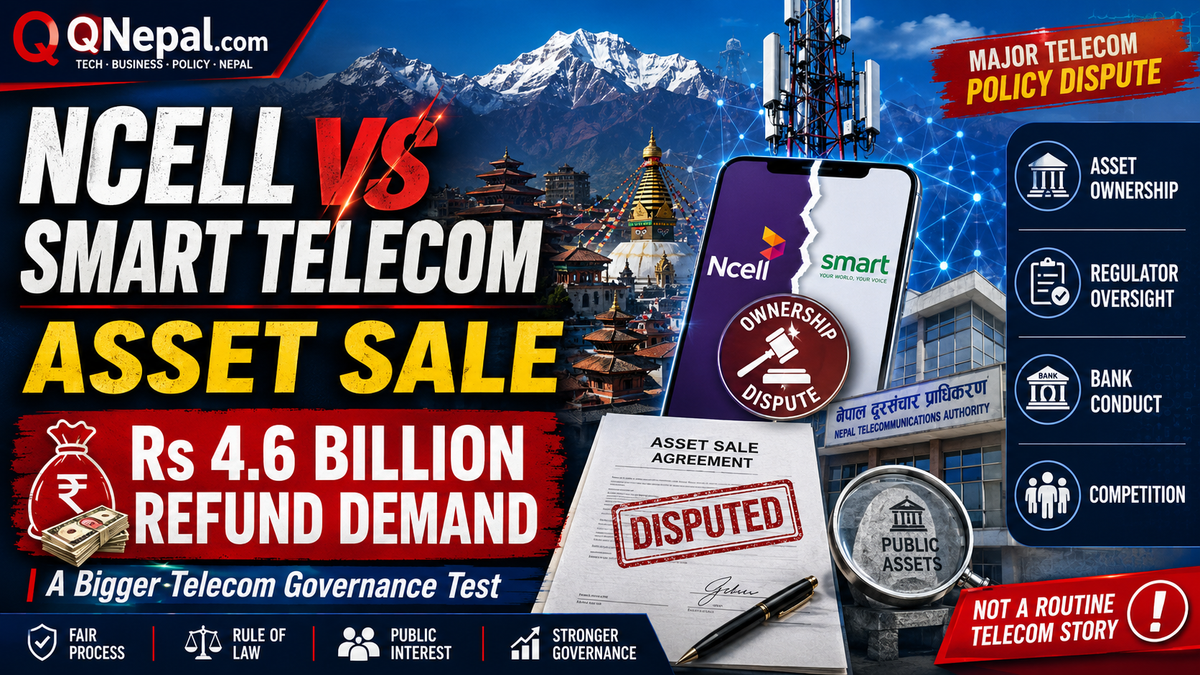
Ncell has reportedly demanded either legal ownership of Smart Telecom’s former network assets or a full refund of the Rs 4.6 billion it paid in a controversial auction. That turns an already sensitive telecom dispute into a much bigger test of how Nepal handles regulator oversight, government-controlled assets, banking conduct, and competition in a strategic sector.
For QNepal readers, this matters more than a routine launch post because the case sits at the intersection of telecom policy, public asset management, and trust in digital infrastructure. If the sale is found to be legally flawed, the implications will not stop with one company. It could affect how future spectrum, infrastructure, and operator exits are handled in Nepal.
What happened
According to TechPana, Ncell sent a formal letter to Nepal Investment Mega Bank after failing to obtain legal ownership of equipment and infrastructure it bought through the Smart Telecom auction. Ncell says it bid Rs 4.6 billion in response to an auction notice published in June 2025, the bid was accepted, and the company later tried to register the assets and integrate them into its network.
But when Ncell sought approval from the Nepal Telecommunications Authority, the authority reportedly said the auction and transfer process did not comply with the law. Ncell has therefore asked for one of two outcomes: complete the legal transfer immediately, or return the full amount paid.
Why the dispute is serious
The central issue is whether those assets could legally be auctioned at all.
Smart Telecom’s operating licence was revoked in April 2023 after the company failed to clear renewal fees and other government dues. Under Nepal’s telecom framework, assets of a telecom operator can come under government control after licence cancellation. NTA had publicly stated in May 2023 that Smart Telecom’s assets were under government control.
That is why the later auction has become so controversial. Investigators are examining whether assets that should have remained under state control were sold anyway, and whether multiple parties acted without valid authority.
Why this matters for Nepal
This is not just a corporate dispute over a failed transaction. It matters in several practical ways:
- Telecom governance: Nepal needs clear rules when an operator exits the market. If those rules are weak or inconsistently enforced, future investors will treat the sector as riskier.
- Public asset protection: If government-controlled telecom assets were transferred improperly, the state could lose both control and revenue.
- Competition and infrastructure: Smart Telecom’s old infrastructure could still matter for network expansion, service quality, and how existing operators strengthen coverage.
- Regulatory credibility: Questions are now being asked not only about the bank and former Smart Telecom officials, but also about how quickly regulators intervened.
Arrests and investigation have raised the stakes
Reporting on the case says Nepal Police’s Central Investigation Bureau is investigating allegations that the auction was carried out in collusion to undermine state ownership rights. Former Smart Telecom chairman Sarbesh Joshi has been arrested, along with other individuals linked to the auction process. TechPana also reports that Nepal Investment Mega Bank CEO Jyoti Prakash Pandey was arrested in connection with the case.
That alone makes this more than a normal business disagreement. Once criminal investigation, public assets, and a major telecom operator are all involved, the story becomes a wider governance issue.
What readers should watch next
The most important question now is not whether the story is embarrassing for one side or another. It is whether Nepal can show a predictable legal process for strategic digital infrastructure.
Readers should watch for four things next:
- whether Ncell receives a refund, asset transfer, or neither in the near term
- whether investigators conclude that the auction itself was unlawful
- whether the government clarifies how telecom assets are handled after licence revocation
- whether the case changes investor confidence in Nepal’s telecom sector
Nepal is already discussing a possible third telecom operator, 4G quality improvements, and future 5G policy. That makes this case even more important. A market cannot attract healthier competition if the rules around operator failure and asset ownership remain unclear.
In short, Ncell’s refund demand is not just another telecom controversy. It is becoming a real test of whether Nepal’s digital infrastructure sector can be regulated in a way that is lawful, transparent, and credible.
Source: TechPana reporting on May 16, 2026. This article is based on currently available reporting and official context around Smart Telecom’s licence cancellation and asset status.